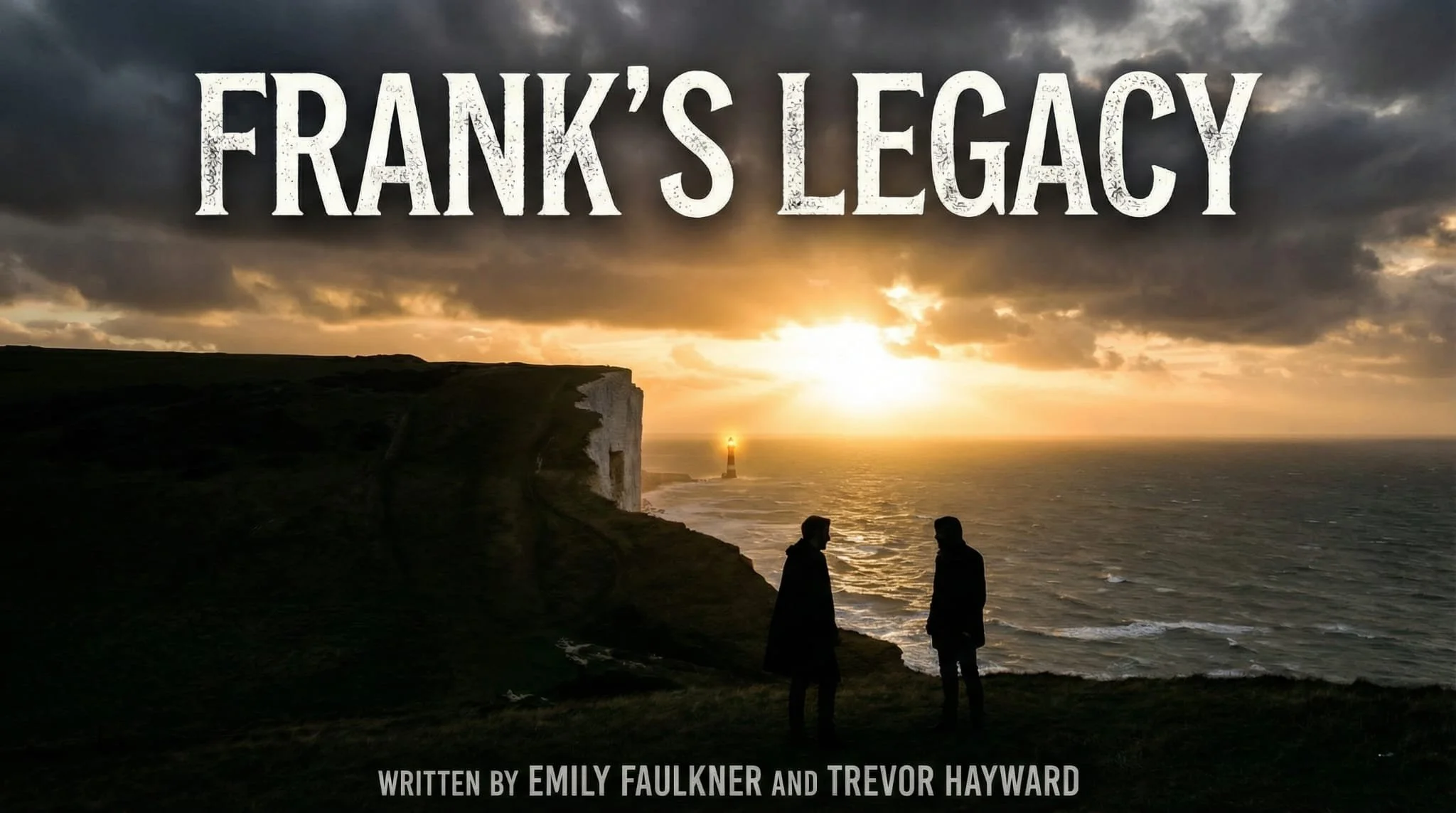
The Anatomy of 'Frank's Legacy': A Screenwriter's Reflection:
By Emily Faulkner, M.A.
When I first sat down to write Frank's Legacy, I knew I was stepping into a precarious narrative space. Writing about severe mental illness requires a delicate balance of unflinching honesty and deep empathy. The script was born out of a desire to explore the terrifying, yet profoundly human, experience of losing one's grip on reality, while simultaneously questioning what "reality" actually is.
Here is a look into my process of bringing Frank's world to the page, and eventually, to the screen.
Conceiving Frank and the Voices:
Frank is a 58-year-old man who is quietly, desperately drowning. I wanted him to feel instantly recognisable—a neighbour, a former colleague, someone whose profound depression has rendered him invisible to the world. On the surface, Frank presents a textbook case of severe depression spiraling into paranoid schizophrenia.
However, the core of the script hinges on the specific nature of his auditory hallucinations.
“The voices Frank hears are not entirely hostile. They murmur strange, esoteric things, but their underlying refrain is a paradoxical comfort: It will be alright in the end."
This was a deliberate choice. I wanted to subvert the usual cinematic trope of the purely antagonistic voice in the head. Frank's voices act almost as a twisted chorus, pulling him away from reality but offering a strange solace that the real world denies him.
His inner voice, depicted in ‘Voice Overs” try to calm and subdue his terrors, but it is also somewhat out of his control.
The Arc of Isolation and Dr. Kedron:
The structural spine of the screenplay traces Frank’s descent into total isolation. I wrote the first two acts to feel deeply claustrophobic. We are locked inside Frank’s deteriorating apartment and, by extension, his deteriorating mind. The less he interacts with the outside world, the louder and more coherent the voices become.
This isolation inevitably leads to his confrontation with the enigmatic Dr. Kedron.
When crafting Kedron, I wanted him to be the ultimate threshold guardian. Is he a real psychiatrist trying to intervene? Is he a manifestation of Frank’s fractured psyche? Or is there a darker, supernatural force at play behind Frank’s illness? I deliberately wrote the script to straddle the line between clinical psychological breakdown and cosmic horror. The ambiguity is the point. I wanted the audience to feel the same disorienting uncertainty that Frank feels.
My Writing Style: Grounding the Surreal:
My background in literature deeply informs my screenwriting style.
I favour psychological realism intertwined with atmospheric dread. When writing Frank's Legacy, I focused heavily on sensory details in the action lines to create a mood of creeping unease:
* Subtext over exposition: I rely on silence, physical tics, and the physical decay of Frank's environment to tell the story of his mind.
* Subjective perspective: The script is written almost entirely from Frank's point of view, ensuring the audience cannot trust what they are seeing or hearing any more than he can.
* Lyrical darkness: I try to find a grim poetry in the bizarre things the voices say, grounding supernatural concepts in very human, mundane pain.
Collaborating with Director Trevor Hayward:
A script is only a blueprint, and handing over Frank's Legacy to Trevor Hayward after seven drafts was a happy conclusion, which fortunately we both agreed on.
Trevor and I share a very similar artistic vocabulary. Where I wrote claustrophobia into the scene descriptions, Trev got it straight away, responding with the suggestion of certain camera shots to capture that feeling.
We spent weeks in pre-production debating the presentation of Dr. Kedron. Trevor pushed me to refine the dialogue in their final confrontation, stripping away anything that tipped the hand too far toward either the "clinical" or "supernatural" explanation. Trevor understands that a director’s job isn’t just to film the script, but to protect its mysteries. His visual execution in previous work will, I’m certain, elevate the words on the page, maintaining the exact psychological tightrope the story requires.
I’m very excited to see the final film which begins shooting in around 2 weeks.
Written by: Emily Faulkner.
‘Frank’s Legacy’ © 2026 Seventh Dream Ventures.